Turn ERP Payment Data Into Faster Cash Flow
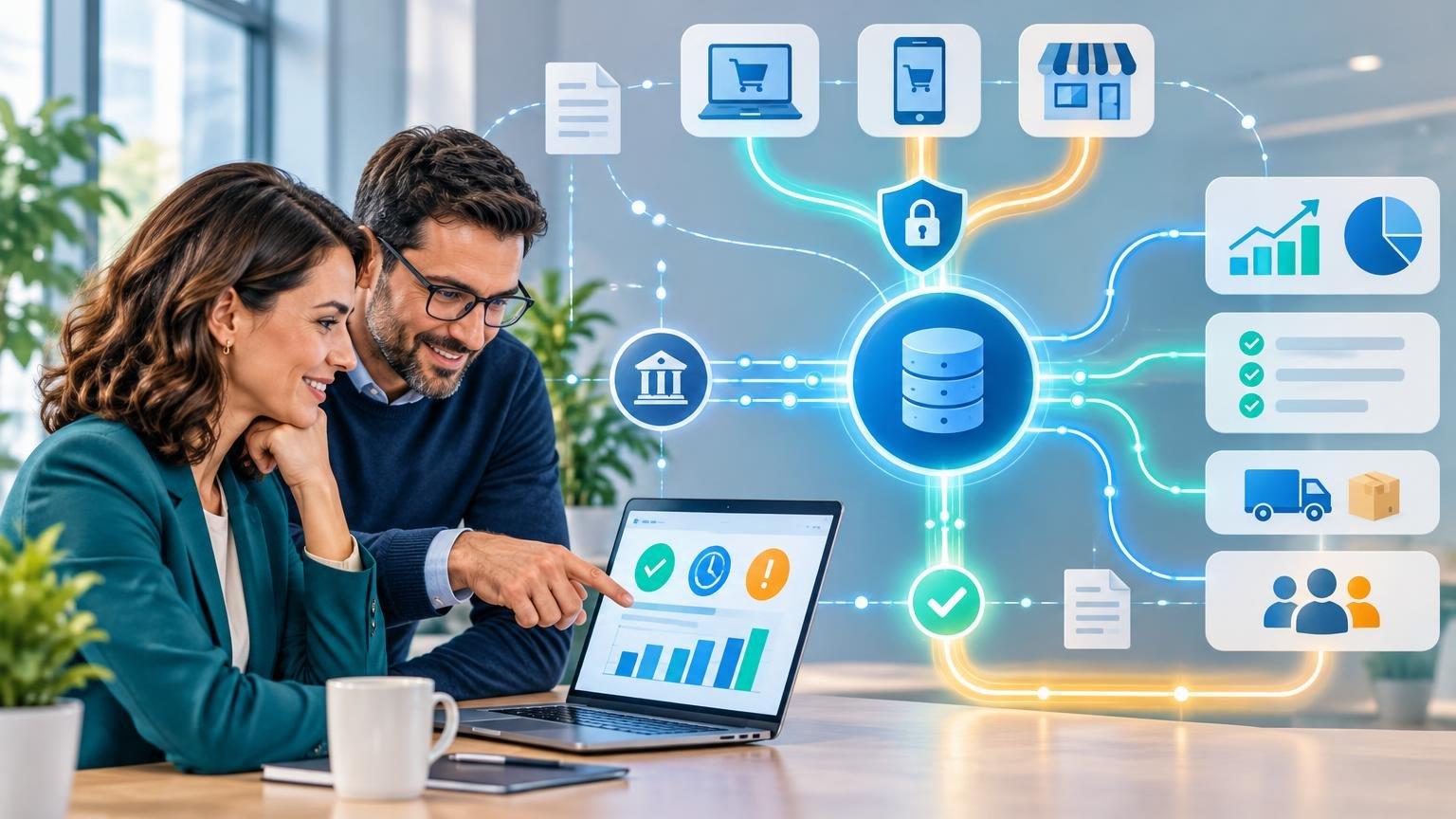
ERP payment gateway integration connects your ERP system to a payment gateway, allowing payment requests, authorisations, settlement updates, refunds and reconciliation data to move automatically between finance, operations and customer-facing systems. Instead of treating payments as a separate task, we help you make them part of the same commercial process that creates invoices, releases orders and manages customer accounts.
Too often, we see growing businesses taking payments in one platform, raising invoices in another and matching bank activity manually at month-end. That creates admin, delays visibility of available cash and introduces errors that can affect working capital. A connected approach gives you a clearer view of what has been paid, what is pending, what has failed and what needs chasing.
Late November is a sensible time to assess this. Before Q1 budgets, supplier renewals and operational priorities are fixed, we recommend reviewing where payment friction is affecting margin and cash control.
What ERP Payment Gateway Integration Actually Does
Your ERP remains the main record for financial and operational activity. The payment gateway is the secure connection layer that routes payment instructions and status messages between your business, the customer, the bank, card scheme or open banking provider. The integration removes the need for teams to rekey the same payment data across several systems.
In practical terms, we can design a payment flow that allows an invoice in your ERP to generate a payment request or link. Once the customer pays, the gateway sends the transaction result back to the ERP. Customer balances update, receipts can be created and any failed or incomplete payment can be flagged for follow-up.
A well-planned setup may support:
- Invoice payment links and online checkout payments
- Automatic updates for approved, declined or pending transactions
- Refund status updates and clearer audit records
- Recurring payment schedules, stored mandates and payment reminders
- Open banking payment options alongside card acceptance
It is important to separate the roles of the systems involved. A payment gateway securely passes payment information. An acquirer processes card transactions. Your ERP records the commercial and accounting outcome. When those roles are disconnected, finance teams can still be left with manual reconciliation even after investing in a standalone payments tool.
When ERP Payments Need a Connected Gateway
The warning signs usually appear in the finance team first. If staff export transaction reports into spreadsheets, manually match remittances to invoices, chase proof of payment or spend days closing the ledger, your payment process deserves a closer look. Those tasks become more expensive and less reliable as transaction volumes rise.
Commercial timing matters too. We recommend reviewing ERP payments before a processor contract renewal, ERP upgrade, acquisition, ecommerce launch or expansion into new sites and sales channels. Rising card processing charges, increasing chargeback ratios and slow settlement can all place pressure on margin and working capital.
For Q1 planning, start by building a clear baseline of your current position:
- Annual payment volumes and average order values
- Payment methods used by customers
- Refund levels, failed payments and chargebacks
- Settlement terms and processing fees
- Time spent by finance teams on reconciliation and exceptions
This baseline turns a broad technology discussion into a P&L decision. It helps us assess whether a connected gateway, a different supplier arrangement or a stronger mix of open banking and card payments is likely to produce a worthwhile return.
Why Disconnected Payments Erode Margin and Control
Headline gateway fees are only one part of the cost. Card scheme charges, interchange fees, acquirer mark-ups, failed payment recovery, refund handling and manual reconciliation all affect EBITDA. A small charge applied repeatedly across a large transaction base can become a meaningful drain on profitability.
Fragmented data also weakens control. Sales may see an order as paid before settlement is confirmed. Operations may release goods or services against incomplete information. Finance may show a customer account as overdue when payment has already been made through a separate channel. The result is avoidable customer friction, inaccurate cash forecasts and poor use of staff time.
We have seen this pattern in multi-site distribution environments where order systems, payment tools and accounting software operate separately. Teams can spend several days matching card payments and bank transfers to invoices each month. By connecting the ERP to a gateway and assessing suitable open banking journeys, the business can reduce manual handling and consider lower-cost alternatives to card acceptance. Savings should always be modelled against the real transaction mix, not assumed.
From our London and Essex base, we have worked with commercially focused organisations since 2016, combining technology planning with FTSE 250-level procurement leverage. In our experience, payment costs, system fit and supplier terms must be assessed together. Treating them as separate projects often leaves value on the table.
How to Integrate ERP Payments Without Operational Disruption
A successful integration starts with a financial and technical baseline, not a rushed software decision. We first map every payment route, including online card payments, invoice links, bank transfers, recurring payments, refunds and supplier payments where relevant. This reveals where data is duplicated, where approval controls are weak and where delays are affecting cash visibility.
The next step is selecting the right connection method. Some ERPs offer native connectors. Others need an API integration or middleware to connect finance, CRM, ecommerce, booking and operational platforms. The right route should support tokenisation, role-based access, audit trails and the appropriate Payment Card Industry Data Security Standard requirements.
We recommend a phased implementation:
- Start with one payment journey, such as invoice payment links
- Test payment status updates, refunds and reconciliation carefully
- Define how failed payments and exceptions are handled
- Assign clear ownership across finance, operations, IT and providers
- Measure reconciliation time, settlement speed, transaction cost and payment queries
Controlled rollout matters because the value sits in the process around the payment, not only in the transaction itself. Clear rules for exceptions, refunds and customer communication help prevent new systems from creating fresh workarounds.
Set a Q1 Plan for Lower Payment Costs
ERP payment gateway integration is a commercial control project, not simply an IT upgrade. The first task is to identify where payment fees, fragmented systems and manual work are reducing margin or delaying a reliable view of cash. A focused review should cover ERP capability, payment providers, transaction fees, settlement terms, reconciliation workload and the suitability of open banking options.
Before replacing any system, establish whether a targeted integration, supplier renegotiation or better payment mix can solve the underlying problem. The strongest plan connects payment operations to the figures that matter most: cash flow, finance-team capacity, customer experience and profitability.
Reduce Payment Costs Without Adding Complexity
Digital Media Technology Solutions helps finance and operations leaders assess whether ERP payments can reduce transaction fees, accelerate settlement and remove manual reconciliation work. We will map the commercial and operational case against your current payment flows, including fee leakage, integration requirements and cash-flow impact. If you need a clear route to lower processing costs and stronger control, contact us to arrange a focused review.